"Token" Changing Hands — From Crypto Coin to AI Building Block
The "token" you're talking about is not the same one you meant three years ago.

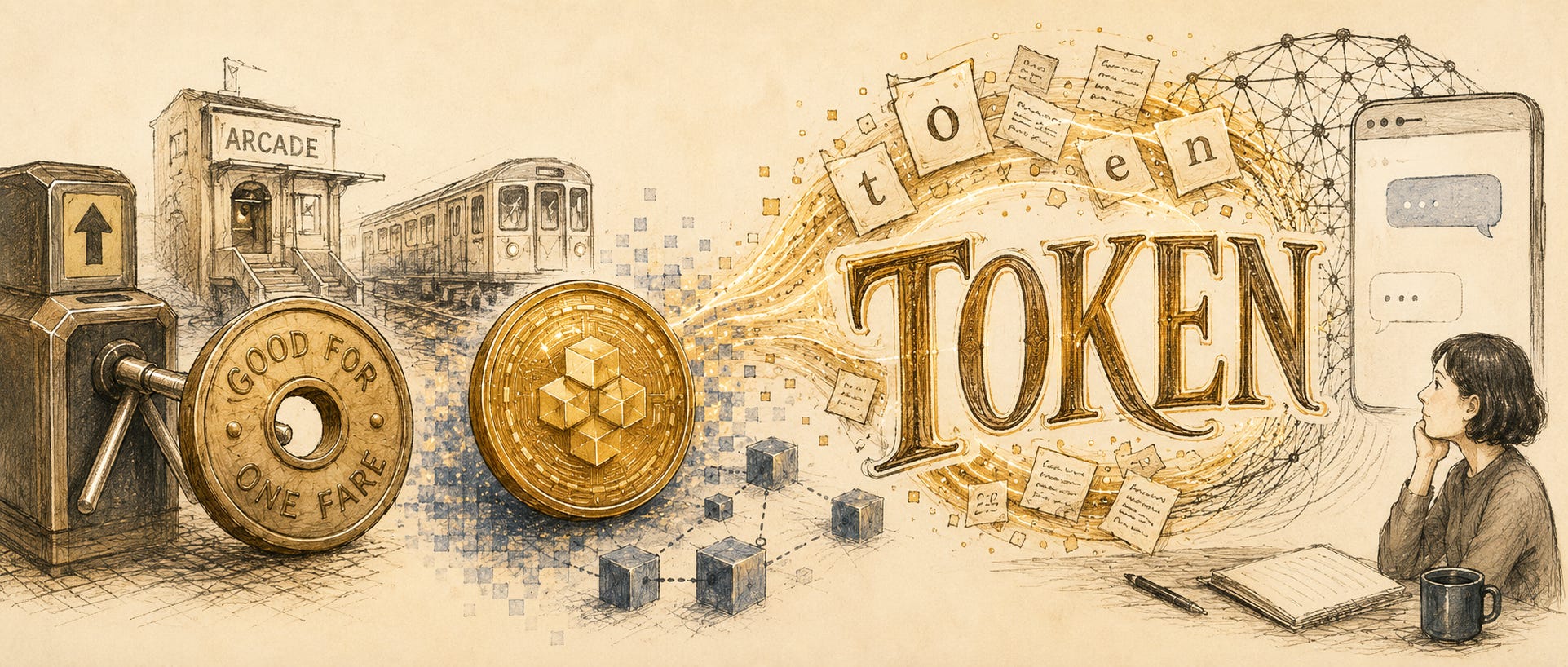
If you’ve ever used a large language model — ChatGPT, Gemini, Claude, DeepSeek — you’ve probably encountered the word token. It shows up in your usage dashboard, in model spec sheets, or in some explainer about how AI actually works. If you’ve had any exposure to cryptocurrency, you met it earlier. Token: the thing in your wallet or exchange account that you buy, hold, and transfer.
The same English word carries two entirely different meanings in two technology domains. In one, it is the smallest unit a machine processes when it reads or generates language. In the other, it is a transferable claim to value on a blockchain. Most people have never stopped to consider that these two senses are even related — much less noticed that, over the past few years, the image that first lights up in their mind when they hear token has quietly shifted.
This article traces the word back to its roots, examines how it was successively adopted by cryptocurrency and artificial intelligence — two defining technology waves of the past fifteen years — and tracks how its center of gravity shifted between them.
The Word’s Origins: An Ancient Marker
Start with what token originally means in English.
The Oxford English Dictionary lists 29 senses for the noun [1]. In everyday usage, they boil down to three main clusters: a substitute coin (a round piece of metal or plastic used instead of money), a symbol or keepsake (something that represents a feeling, a fact, or an event), and a technical term in linguistics and computer science — the smallest meaningful unit extracted from a sequence of data. The word also works as an adjective meaning “symbolic, perfunctory” — a token gesture, a token fee.
These senses look scattered, but they share a single etymological root. Token descends from Old English tācen (mark, sign, evidence), which is cognate with German Zeichen (sign). Further back, it traces to the Proto-Indo-European root *deik- (to show, to point), the same root that gave Latin index and English diction [2]. The word’s deep logic has always been the same: it is not the thing itself; it points elsewhere, standing in for something else.
Every subsequent meaning the word acquired is a variation on this logic. In the Middle Ages it meant a keepsake — standing in for a bond of affection. Later it meant a pledge exchanged at the sealing of a contract — standing in for a promise. By the late sixteenth century it had added “a metal disc resembling a coin,” its face value set by whoever issued it — standing in for real money. The token you drop into a subway turnstile or an arcade machine descends from this branch. Its value is determined by what it can be exchanged for.
From substitute coin to keepsake to contractual pledge, token has always done the same thing: standing in for something else. It is not the destination; what it points to is. This logic determined what kind of new concepts would come looking for it.
“Token” — The Crypto Coin
In the blockchain and cryptocurrency world, token underwent a clear process of semantic differentiation, and its starting point was a different word: coin.
In 2008, Satoshi Nakamoto published the Bitcoin white paper, subtitled “A Peer-to-Peer Electronic Cash System.” In 2009, the Bitcoin network went live [3]. Bitcoin’s core technology is a cryptographic distributed ledger: transaction records are not stored on a central server but jointly maintained and verified by every node in the network — hence the term “chain.” The native currency running on this chain was called bitcoin, and since its stated purpose was electronic cash, calling it a coin was natural. Subsequent blockchain projects — Litecoin, Dogecoin, and many others — followed the same convention: each had its own chain, its own ledger, and its own coin serving as the chain’s native currency.
Before Ethereum, the embryonic form of on-chain assets had already appeared in the Bitcoin ecosystem. In 2012–2013, a group of developers proposed the concept of “colored coins”: marking Bitcoin’s smallest units to represent off-chain assets — equity, bonds, even physical commodities. In these discussions, token was already being used to describe “an on-chain marker that represents something else.” This usage was directly inherited by Ethereum’s founder, Vitalik Buterin — he had participated in the colored coins project before creating Ethereum, and one of his motivations for building Ethereum was precisely that what colored coins could do on Bitcoin was too limited.
Ethereum launched in 2015, bringing a key innovation: the smart contract. Smart contracts allowed people to issue assets directly at the code level of Ethereum’s blockchain, without building a chain from scratch. In November of that year, the ERC-20 standard formalized this process [4]: anyone who wrote a contract conforming to ERC-20 could mint their own asset on Ethereum. The colored coins vision finally had truly usable infrastructure.
These assets, parasitic on Ethereum’s chain, needed a name to distinguish them from coins with chains of their own — and the name required almost no debate. Linguistics has a branch called onomasiology, which studies why a new concept ends up landing on a particular word [5]. Here, coin didn’t fit, because it implies “money,” while what ERC-20 produced was, more often than not, a claim on a project’s future — closer to an equity certificate than to cash. Token‘s core meaning — a thing that represents something else — covered this “equity” layer neatly. Vitalik and the early Ethereum community used the word from the start; the ERC-20 standard’s official title is simply “Token Standard.” The derivative concepts that followed — token economics, token rights, tokenization — all grew from the token root. A 2023 linguistic study found that token ranked seventh among high-frequency cryptocurrency terms (behind exchange, crypto, trading, blockchain, asset, and cryptocurrency), defined as “a digital representation of an asset value” [6] — a definition that reads almost like a modern translation of the word’s original meaning.
With the name settled, the numbers exploded. In the years following Ethereum’s launch, ERC-20 tokens proliferated rapidly across a wide range of uses: dollar-pegged stablecoins (USDT migrated to Ethereum in 2017, followed by USDC and DAI), exchange platform tokens, utility tokens for decentralized applications, and vast numbers of projects raising money from the public on the strength of nothing more than a white paper. During the ICO (Initial Coin Offering) frenzy of 2017–2018, thousands of projects raised funds by issuing ERC-20 tokens, with cumulative fundraising exceeding $13 billion over two years [7]. The word token surged in usage within the crypto community, becoming the industry’s standard term for non-coin on-chain assets — and eventually came to be used almost interchangeably with coin.
It was precisely this “equity certificate” connotation that got token into legal trouble. The central regulatory dispute around crypto has always been whether a given token constitutes a security. The SEC’s primary analytical tool for this question is the Howey Test: if an asset qualifies as an “investment contract,” it is a security and falls under the Securities Act. In 2017, the SEC’s investigation report on The DAO was the first to conclude that a digital asset constituted a security; the press release title read: “DAO Tokens, a Digital Asset, Were Securities” [8]. Two years later, the SEC’s analytical framework placed “virtual currencies, coins, and tokens” collectively under the heading of “digital asset” [9]. The debate remains unresolved. The SEC’s concern is economic substance — whether an asset constitutes an investment contract — not etymology. But the fact that token has leaned toward “claim” rather than “currency” since the day it was chosen has, objectively, placed it under the regulatory spotlight.
As token became bound to crypto, the industry’s scale continued to grow. After DeFi (decentralized finance) took off, total value locked rose from roughly $1 billion in early 2020 to approximately $260 billion by December 2021. By 2024, mainstream price-tracking sites listed over ten thousand crypto assets; then, in the second half of the year, meme coin platforms like Pump.fun pushed the number of newly minted on-chain tokens into the millions, the vast majority lacking any sustained liquidity [10]. Each incremental rise in the industry’s scale tightened the association between token and “crypto.”
For people outside the crypto industry, many of blockchain’s core concepts — decentralization, consensus mechanisms, smart contracts — remain, seventeen years after Bitcoin’s birth, too abstract for ordinary people to grasp intuitively. Out of the mountain of crypto-native slang (HODL, whale, shitcoin, to the moon), virtually the only term that broke through into mainstream language was token. Perhaps precisely because the word is plain enough, everyday enough — a coin substitute, a voucher — it became the nearest point of entry for ordinary people trying to understand what this industry actually does.
“Token” — AI’s Building Block
During the years when crypto was busy developing tokens and attaching new meaning to the word, another sense of token had been sitting quietly in the dictionary all along.
In computer science, token has always meant the smallest processing unit extracted from a text. Compilers analyzing code, programs parsing natural language — for decades, the word has been used in this way. Going further back, the logician C.S. Peirce drew the distinction between type and token in 1906: a page with twenty printed instances of the contains twenty tokens, but only one type [11]. This lineage runs straight to today’s AI. It is far older than Bitcoin.
In the context of today’s large language models, token can be understood as follows: before the model processes text, it breaks the input into small fragments — these fragments are tokens. One token corresponds roughly to one English word or a short stretch of punctuation and whitespace. Everything the model does — understanding your question, generating a response — happens token by token. How much you say to the AI and how much it says back ultimately reduces to a token count.
So strictly speaking, AI did not “steal” this word from the blockchain industry, nor did it change its meaning. What happened is subtler: the definition stayed the same, but the thing that “smallest processing unit” now processes has become incomparable to what it once was.
In November 2022, OpenAI released ChatGPT, and a large language model entered ordinary people’s daily lives for the first time. GPT-3 had already stunned the industry, but its usage barrier confined it to the developer community; ChatGPT’s conversational interface removed that barrier, reaching 100 million users within two months [12]. In 2023, GPT-4 introduced multimodal capabilities, extending token from pure text to image comprehension. The industry began to recognize that scaling laws — bigger models, more data, better performance — were not an academic hypothesis but a viable engineering bet. A global model arms race followed: Google’s Gemini, Anthropic’s Claude, X’s Grok, and from China, Kimi, DeepSeek, Qwen, Doubao, and Pangu. In early 2025, DeepSeek used an efficient architecture to push inference costs dramatically lower, triggering an industry-wide price war — the unit price of a token was collapsing, but total call volume was exploding [13]. By 2026, multimodal models and AI agents had become mainstream: a single AI-generated video might consume tens of millions of tokens; an autonomous agent completing a workflow might consume hundreds of thousands [14].
The definition of “smallest processing unit” remains unchanged, but what it carries is unrecognizable. A decade ago, token was a footnote in a compiler manual. Today, it is the base unit of measurement for a system that ingests the entire internet’s worth of text and runs on hundreds of thousands of GPUs.
What truly embedded the word in everyday awareness was AI’s pervasive adoption. The speed at which large models went from technical breakthrough to mass use far exceeded that of blockchain and cryptocurrency. Writing emails, building presentations, debugging code, researching, translating — as AI tools spread across work and daily life, people inevitably encountered the concept of token. It appeared in API billing dashboards, in model capability comparisons, in popular articles explaining how AI works. Some companies even began tracking employees’ token consumption as a KPI. On social media, a flood of AI-themed content kept the word in front of hundreds of millions of viewers. This penetration was systemic; billing was only one of many touchpoints.
The data confirms the speed. Globally, OpenRouter’s platform data shows that the top ten models’ weekly token call volume was approximately 1.24 trillion in March 2025; by February 2026 it had surged to roughly 13.95 trillion — more than a tenfold increase in under a year [15]. Goldman Sachs projects that AI agent adoption will drive a further 24-fold increase in global monthly token consumption between 2026 and 2030 [16]. At the same time, every token processed requires real compute — a single NVIDIA H100 GPU lists at $25,000 to $40,000 [17], and throughput scales roughly with hardware cost. This reveals a structural difference between the two tokens: both crypto tokens and AI tokens involve electricity and silicon, but their marginal cost structures are fundamentally different. Minting an ERC-20 token has near-zero marginal cost (once the contract is deployed, issuing an additional token costs almost nothing). Processing an additional AI token, by contrast, consumes an incremental unit of inference compute — the cost is rigid. One is a near-zero-marginal-cost certificate; the other is a unit of computation that burns real capital with every instance.
A Silent Transfer of Naming Rights
Total cryptocurrency market capitalization peaked at roughly $3 trillion in November 2021 [18], then was halved to approximately $800 billion by November 2022 following the Terra/Luna collapse, the bankruptcy of Three Arrows Capital, and the implosion of FTX. It was during those same two years that AI token call volume began its thousand-fold ascent. One tide going out, another coming in.
For an ordinary person, the “switch” happens in some barely perceptible region of the mind. Linguistics has a concept called a frame: a word does not exist in isolation in your head but activates an entire network of background imagery and associated concepts. Today, token can activate at least three distinct frames. In the everyday frame, it is still the coin substitute in a locker or arcade. In the blockchain frame, it represents a transferable on-chain claim — a catch-all term for crypto project assets. In the AI frame, it represents a unit of compute — a fragment of machine thought, sliced off and priced by the piece. When you hear token now, it carries several entirely different layers of meaning.
The critical shift is which frame lights up first. Whether token first summons a casino chip, a crypto chart, or a ChatGPT usage meter depends roughly on what year you started paying attention to the word. When people say “the word has changed,” what they mean, precisely, is that the default frame has been replaced.
One observable signal is the migration of token‘s collocates. The linguist J.R. Firth long ago observed that a word’s meaning is often revealed by the company it keeps. A few years ago, token most frequently appeared alongside blockchain, crypto, sale, wallet, holder. Today its high-frequency neighbors are input, output, context window, limit, usage. This does not mean crypto has “lost” the word. The blockchain world will continue to use token, and its meaning in that context is stable enough. What has happened is closer to a word undergoing parallel specialization in two technological domains. It is just that, at the level of general public awareness, the default frame has switched.
How fast did it spread? A new phenomenon typically diffuses through a population along an S-curve: slow start, steep middle, plateau. Token’s AI sense nearly skipped the slow-start phase and jumped straight to the steep middle, because AI products themselves penetrated so fast. From ChatGPT’s launch in November 2022 to AI agents being ubiquitous in early 2026 took just over three years. Cryptocurrency’s journey from Bitcoin to DeFi Summer took twelve.
And crypto’s string of high-profile scandals — the FTX implosion, the Luna/Terra collapse — attached negative connotations to the word. In the public imagination, token became briefly associated with scams and worthless assets. AI’s arrival, in a sense, rehabilitated the word’s reputation. Today, if someone outside the crypto world hears token, what lights up is most likely AI’s unit of compute, not a digital asset.
Shifts in vocabulary are never isolated events. Which words are surging, which are quietly receding, which old words are suddenly loaded with new weight — these changes faithfully record where a society’s attention is flowing. They emerge from countless people using the word in their own contexts, gradually converging. The linguist Rudi Keller called this mechanism “the invisible hand in language” [19]. Seen this way, every conversation any person has with a large language model is a small part of this ongoing linguistic evolution.
What Comes Next
One English word, chosen twice in fifteen years by two successive technology waves — blockchain and artificial intelligence — each attaching an entirely new meaning to it.
Looking at the word’s trajectory, token was originally a broad, everyday word. Crypto was the first to stain it with a heavy, industry-specific meaning. But crypto never managed to fully claim it — never turned it into an industry-exclusive term the way it did with blockchain or cryptocurrency. The crypto world developed all manner of narratives over the years, but its technology did not land broadly enough, regulation remained perpetually unresolved, and a cascade of scandals eroded trust. Token‘s positive associations in the public mind remained limited. When the AI wave arrived, the word’s definitional space was still open. AI took over a large swath of it, transforming token from a piece of jargon tinged with speculation into the base unit of measurement for an entire industry’s value chain.
This situation is remarkably rare. In contemporary technology, few words simultaneously occupy the position of describing a core product in two massive industries with heavily overlapping audiences. The closest analogy may be security — in finance it means a tradeable financial instrument; in information technology it means protecting systems from threats. But security‘s two senses belong to almost entirely non-overlapping usage contexts: a financial asset and a system state. They share neither grammatical structure nor economic attributes, and rarely collide in practice.
Token is thornier, because in both contexts it is an economic unit bound to value — a crypto token has a market price, is tradeable, is an asset; an AI token has a unit price, is consumable, is a cost. Both are counted individually, both can be expensive or cheap, both are things you spend money on. This shared economic nature makes the two meanings overlap almost completely in grammar and commercial language. “The token is expensive” — without context, you cannot tell whether the speaker is reading a price chart or an API bill.
Blockchain started first; AI overtook it later. The two industries followed very different development paths, yet happened to choose the same word to describe their most fundamental unit. As things stand, AI has gained the upper hand not only in industry scale and mainstream adoption, but has also — for now — captured the word’s default meaning. But this story may not be over. As concepts like tokenized compute and on-chain AI agents continue to emerge, the intersection of blockchain and artificial intelligence is quietly growing. Where token goes next — whether toward further divergence, or toward a new meaning born at the convergence of two industries — remains to be seen.
This is an interesting era. We can observe it not only through the technology itself, but through the fate of a single word.
Follow me for ongoing coverage of the shifting rules at the intersection of AI, blockchain, and law.
References
[1] OED, token, n., 29 senses, last revised Mar. 2026. oed.com
[2] Etymology per Etymonline, Merriam-Webster, Collins: OE tācen → Proto-Germanic *taikną → PIE *deik- (to show, to point).
[3] Satoshi Nakamoto, “Bitcoin: A Peer-to-Peer Electronic Cash System,” Oct. 31, 2008. Network launched Jan. 3, 2009.
[4] Fabian Vogelsteller & Vitalik Buterin, ERC-20 (EIP-20), Nov. 2015. eips.ethereum.org/EIPS/eip-20
[5] Geeraerts, Theories of Lexical Semantics (2010), on onomasiology.
[6] Casañ-Pitarch (2023), “The Language of Cryptocurrencies,” Íkala 28(1). Token ranked 7th among high-frequency crypto terms.
[7] ICO fundraising per ICObench / CoinDesk: ~$5.6B in 2017, ~$7.8B in 2018. DeFi TVL per DeFi Llama.
[8] SEC, Report of Investigation Pursuant to Section 21(a): The DAO, 2017. sec.gov
[9] SEC, Framework for “Investment Contract” Analysis of Digital Assets, 2019. sec.gov/files/dlt-framework.pdf
[10] Tracked crypto assets per CoinMarketCap / CoinGecko: ~13,000–17,000. Pump.fun and similar meme coin platforms have minted millions of tokens since mid-2024. demandsage.com; dune.com
[11] C.S. Peirce, type/token distinction, 1906.
[12] ChatGPT launched Nov. 30, 2022; 100M users within two months. reuters.com
[13] DeepSeek-V3 reduced inference costs via MLA and other architectural innovations, triggering a 2025 price war among model providers.
[14] CEIBS research report (ceibs.edu, Apr. 2026): AI-generated video can consume tens of millions of tokens; agent workflows can reach hundreds of thousands to millions.
[15] OpenRouter data: top-10 model weekly token volume ~1.24T (Mar. 2025) → ~13.95T (Feb. 2026).
[16] Goldman Sachs Research, May 5, 2026: monthly global token consumption projected to increase 24× between 2026 and 2030. goldmansachs.com
[17] NVIDIA H100 list price ~$25,000–$40,000, per GMI Cloud / IntuitionLabs.
[18] Total crypto market cap peaked at ~$3T (Nov. 2021), fell to ~$800B (Nov. 2022) following Terra/Luna, Three Arrows Capital, and FTX. CoinMarketCap
[19] Keller (1994), On Language Change: The Invisible Hand in Language. Frame semantics per Fillmore (1982). S-curve diffusion per Rogers (1962).